Microcement vs Cement Screed
Microcement vs Cement Screed in Singapore
Is microcement the same as cement screed?
No. Cement screed is a 20–50mm structural substrate made from cement, sand and water, while microcement is a 2–3mm decorative finish made with cement, polymer resin, pigment and aggregate. Screed usually sits under tile or vinyl; microcement is sealed in 2 coats and costs S$30–70/sqft.
Not the same thing.
Cement screed is the structural base under your finish. Microcement is the decorative surface you see and touch. People mix the two up constantly — here is the clean distinction.
This page compares the two build-up layers only. For pricing, scopes and where microcement is installed across a whole home, see the microcement Singapore pillar.
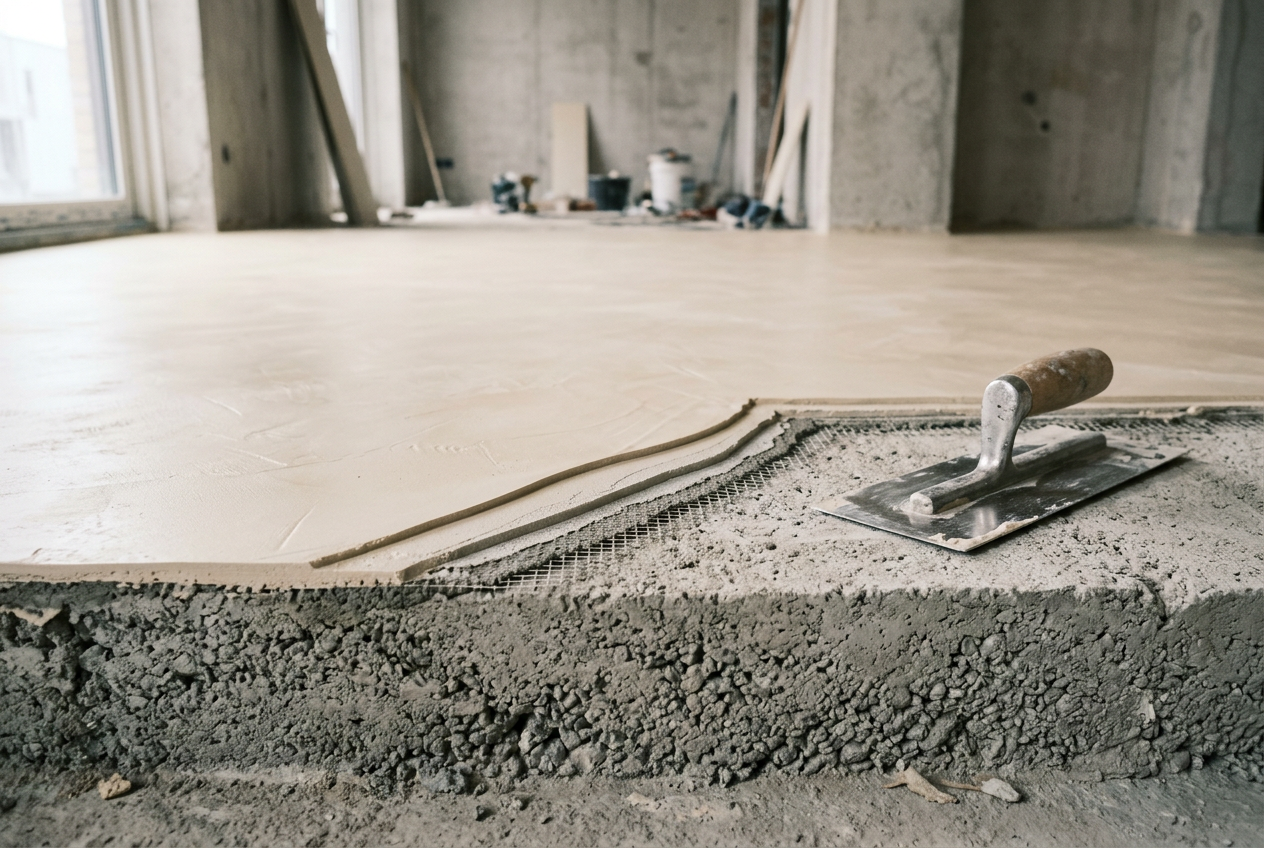
Microcement vs cement screed at a glance
| Cement screed | Microcement | |
|---|---|---|
| Role | Structural substrate | Decorative finish |
| Thickness | 20–50mm | 2–3mm |
| Composition | Cement + sand + water | Cement + polymer resin + pigment + aggregate |
| Look | Grey, utilitarian, hairline cracks | Continuous, hand-trowelled, sealed cream tones |
| Where | Under tile, vinyl, or as raw industrial floor | Walls, splashbacks, bathroom walls, feature floors |
| Sealer needed? | Optional | Always (2 coats) |
| Cost | $4–7/sqft | $30–70/sqft |
How the two layers stack in a real build-up
In almost every Singapore renovation the two are not alternatives — they are neighbours in the same sandwich. From the slab upward:
- Structural concrete slab. The developer's floor. Never touched in a normal reno.
- Cement screed, 20–50mm. Poured to correct level, fall and services routing. This is what makes a floor flat.
- Primer and mesh. Bonding coat, plus fibreglass mesh where movement or grout lines need bridging.
- Microcement, 2–3mm. Two to three hand-trowelled layers, each thinner than a coin.
- Polyurethane sealer, 2 coats. The layer that actually resists water, stains and abrasion.
The practical consequence: screed problems become microcement problems. A screed with the wrong fall, trapped moisture or live cracking will telegraph straight through a 2mm finish, which is why we check substrate before quoting any floor.
"Screed floor" is usually one of three things
- Raw cement screed. Industrial look, exposed substrate, sealed. Cheap, but greys aggressively and hairline-cracks.
- Polished concrete. Mechanically ground and sealed. Much more expensive than screed; closer to microcement in finish but not the same.
- Microcement floor. A 2–3mm decorative layer over screed. This is what most Singapore homeowners actually mean.
Durability and repair — the honest comparison
- Cracking. Raw screed cracks as a matter of course; it is a mass of cement drying against restraint. Microcement over a mesh layer resists hairline movement, but cannot bridge a live structural crack.
- Water. Unsealed screed absorbs and stains permanently. Sealed microcement sheds water, which is why it is specified in showers and splashbacks.
- Repairs. Screed is patched with more screed and never matches. Microcement is patched, feathered and the affected plane re-sealed so the finish reads continuous.
- Service life. Screed lasts as long as the slab. Microcement's life is governed by its sealer, refreshed every 4–6 years on hard-worked floors.
Timeline and disruption
A screed pour needs 24–48 hours before foot traffic and, as a rule of thumb, roughly one day of drying per millimetre before a moisture-sensitive finish can go over it — a 40mm screed can hold a project for weeks. Microcement over an existing cured screed is far quicker: 3–4 working days for a feature wall, around nine for a full-plaster bathroom, because each thin layer cures in hours rather than days.
When to choose which
If you like the look of grey, brutalist screed — you are usually looking at microcement on a feature wall, not raw screed on the floor. Raw screed is unforgiving in a humid HDB. For dry-area floors, the SPC microcement-vinyl plank gets you most of the aesthetic at a fraction of the cost and zero hairline cracks. For wet-area floors and bathroom walls, authentic plaster — see the microcement bathroom page.
FAQ
Is microcement the same as cement screed?
No. Cement screed is a 20–50mm structural substrate (the base under your tile). Microcement is a 2–3mm finish (the surface you see). One is structural, the other is decorative.
Can I put microcement over cement screed?
Yes — and that is the textbook substrate. A flat, cured cement screed is the cleanest base for microcement plaster.
Is cement screed cheaper than microcement?
On its own, yes. Screed alone is roughly $4–7 per sqft. Microcement plaster finish is roughly $30–55 per sqft (walls) or $35–70 per sqft (floors). The screed is the canvas; the microcement is the artwork.
How long must new screed dry before microcement?
Plan on roughly one day per millimetre of screed thickness, and always confirm with a moisture reading before the primer goes down. Trapped moisture is the single most common cause of a finish lifting.
Can microcement fix an uneven screed floor?
No. At 2–3mm it follows whatever it is laid on. Levelling is a screed or self-levelling-compound job that must be done first.